Build a segment for "custom bouncers", where number of visits with exactly one hit OR exactly two hits is true. | Community
Skip to main content
New Participant
April 29, 2022
Solved

Build a segment for "custom bouncers", where number of visits with exactly one hit OR exactly two hits is true.

  • April 29, 2022
  • 1 reply
  • 537 views

Hi All,


I want to build a segment or metric for "custom bouncers", where number of visits with exactly one OR exactly two Hits is given.


Background: In the underlying case, a custom link tracking call is implemented, which automatically fires if a vistior enters a page. In other words: the Visitor fires both a page view and custom link tracking call automatically, so the visit is not considered as a bounce. That means, a for us a "bounce" in that case is someone who produces exactly two Hits.


The classical Adobe ‘Bounces’ metric shows the number of visits that contained exactly one hit.

--> How can I set up a metric or a segment for those visits, that contained exactly two hits and nothing more afterwards?


The bounce rate based on single page visits ("Single Page Visits" / "Entries") is not suitable for me in that case, since I am interested in those visits/ visitors, who interact on a certain page, without necessarily visiting another page.


Thanks in advance!



This post is no longer active and is closed to new replies. Need help? Start a new post to ask your question.
Best answer by Jennifer_Dungan

You are correct the default "Bounces" is based on "single hit", and the Bounce "Rate" is bounces/entries...


But if you are interested in people who came to and interacted with only a single page, you could do a segment based on Single Page Visit exists (this would cover a single page view and any number of hits on that specific page). This wouldn't however be limited to only 2 hits if you really need that.


(note that in this case, hit or visit level segment shouldn't make a difference)


I am not sure your use case... if you are just trying to get "bounces" based on a definition of they only visited one page (even if they interacted with that page), consider them a bounce. In this case that would work.


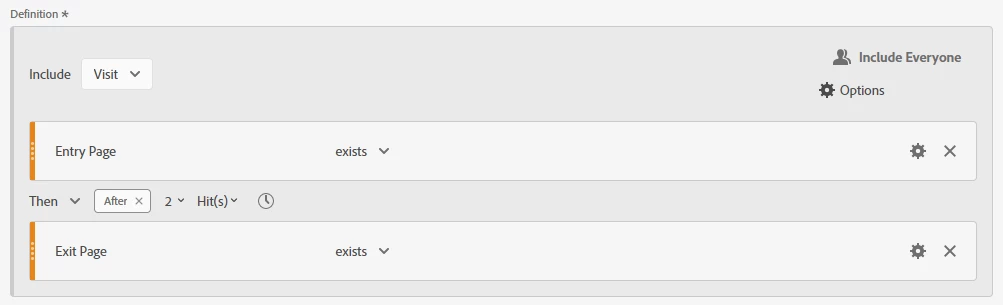
If it needs to be limited to exactly one page view and one hit, that becomes trickier. You could try a visit level segment where "Entry Page" exists, then after 2* hits, "Exit Page" exists.


* Note: I did "after 2 hits" because there is both a page view and an exit, when I tried 1 hit I didn't get any data. But when I compared my test segments, the "Entry, Exit after 2 Hits" segment was slightly smaller than my "Single Page View" segment, which makes sense, cause some of my pages could have multiple interactions on a single page.


Hopefully some of these ideas can be used to create a segment that works for you.


1 reply

Jennifer_Dungan
Jennifer_DunganAccepted solution
New Participant
April 29, 2022

You are correct the default "Bounces" is based on "single hit", and the Bounce "Rate" is bounces/entries...


But if you are interested in people who came to and interacted with only a single page, you could do a segment based on Single Page Visit exists (this would cover a single page view and any number of hits on that specific page). This wouldn't however be limited to only 2 hits if you really need that.


(note that in this case, hit or visit level segment shouldn't make a difference)


I am not sure your use case... if you are just trying to get "bounces" based on a definition of they only visited one page (even if they interacted with that page), consider them a bounce. In this case that would work.


If it needs to be limited to exactly one page view and one hit, that becomes trickier. You could try a visit level segment where "Entry Page" exists, then after 2* hits, "Exit Page" exists.


* Note: I did "after 2 hits" because there is both a page view and an exit, when I tried 1 hit I didn't get any data. But when I compared my test segments, the "Entry, Exit after 2 Hits" segment was slightly smaller than my "Single Page View" segment, which makes sense, cause some of my pages could have multiple interactions on a single page.


Hopefully some of these ideas can be used to create a segment that works for you.