Can not use OSGi Service in WCMUsePojo class | Community
Skip to main content
New Participant
April 12, 2018
Solved

Can not use OSGi Service in WCMUsePojo class

  • April 12, 2018
  • 14 replies
  • 7294 views

I want to read OSGI run mode configurations with OSGI R6 annotation (the code above).

I found the error in the log file and the applicationConfiguration variable in ComponentApi class always have null value.

Any wrong in my code?

This post is no longer active and is closed to new replies. Need help? Start a new post to ask your question.
Best answer by Vijayalakshmi_S

Hi,

I tried to execute your code in my local (in your original post) and I was able to reproduce your issue of service Object being null.

When I changed the service name in my Impl Class, it works. Adding the complete snippet for your reference.

(in Pojo class, I added a getter for addressApi for testing the value entered via OSGI config)

AppConfig.Java

@ObjectClassDefinition(name = "Sprint2AEM - Application Configuration", description = "This contains all application configuration")

public @interface AppConfig {

@AttributeDefinition(name = "address.api",description = "Domain",type = AttributeType.STRING)

String getAddressApi() default "";

}

ApplicationConfiguration.java:

public interface ApplicationConfiguration {

     public String getAddressApi();

}

ApplicationConfigurationImpl.java:

import org.osgi.service.component.annotations.Activate;

import org.osgi.service.component.annotations.Component;

import org.osgi.service.component.annotations.Modified;

import org.osgi.service.metatype.annotations.Designate;

import org.slf4j.Logger;

import org.slf4j.LoggerFactory;

@Component(service = ApplicationConfiguration.class,immediate = true)

@Designate(ocd = AppConfig.class)

public class ApplicationConfigurationImpl implements ApplicationConfiguration{

     private static final Logger LOG = LoggerFactory.getLogger(ApplicationConfigurationImpl.class);

     private String addressApi;

  @Activate

  @Modified

   private void activate(AppConfig appConfig){

      this.addressApi = appConfig.getAddressApi();

   }

     @Override

   public String getAddressApi() {

      return addressApi;

   }

}

ComponentApi.java(Extending WCMUsePojo)

import org.slf4j.Logger;

import org.slf4j.LoggerFactory;

import com.adobe.cq.sightly.WCMUsePojo;

public class ComponentApi extends WCMUsePojo{

     private static final Logger LOG = LoggerFactory.getLogger(ComponentApi.class);

     private String apiUrl="";

     private String addressApi;

@Override

public void activate() throws Exception {

         ApplicationConfiguration applicationConfiguration = getSlingScriptHelper().getService(ApplicationConfiguration.class);

         LOG.info("App configuration Service Object Test=="+applicationConfiguration);

         addressApi = applicationConfiguration.getAddressApi();

        //apiUrl = addressApi + get("apiUrl", String.class);

}

public String getAddressApi() { return addressApi; }

public String getApiUrl() { return apiUrl; }

}

HTL Code:

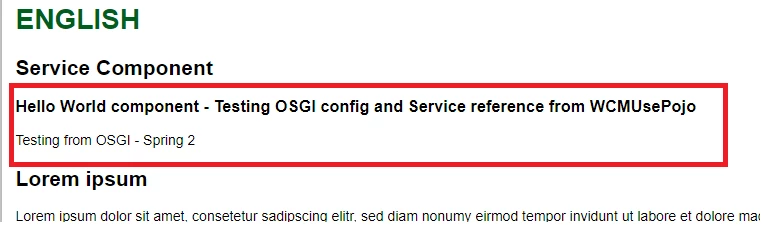
<h3>Hello World component - Testing OSGI config and Service reference from WCMUsePojo</h3>

<div data-sly-use.obj="com.aem.learnings.core.ComponentApi">

${obj.addressApi ? obj.addressApi : "Not from pojo/OSGI Config"}      

</div>

Screenshots:

14 replies

AdobeID24
New Participant
September 29, 2018

we can not make a WCMuse \WCMusePOJO class a component by using @Component ? and we can not use any service inside the wcmusePOJO by using @Reference

New Participant
April 16, 2018

Thanks all for response.

Following the code of @

smacdonald2008
New Participant
April 13, 2018

Great response - we marked that as correct!

Vijayalakshmi_S
Vijayalakshmi_SAccepted solution
New Participant
April 13, 2018

Hi,

I tried to execute your code in my local (in your original post) and I was able to reproduce your issue of service Object being null.

When I changed the service name in my Impl Class, it works. Adding the complete snippet for your reference.

(in Pojo class, I added a getter for addressApi for testing the value entered via OSGI config)

AppConfig.Java

@ObjectClassDefinition(name = "Sprint2AEM - Application Configuration", description = "This contains all application configuration")

public @interface AppConfig {

@AttributeDefinition(name = "address.api",description = "Domain",type = AttributeType.STRING)

String getAddressApi() default "";

}

ApplicationConfiguration.java:

public interface ApplicationConfiguration {

     public String getAddressApi();

}

ApplicationConfigurationImpl.java:

import org.osgi.service.component.annotations.Activate;

import org.osgi.service.component.annotations.Component;

import org.osgi.service.component.annotations.Modified;

import org.osgi.service.metatype.annotations.Designate;

import org.slf4j.Logger;

import org.slf4j.LoggerFactory;

@Component(service = ApplicationConfiguration.class,immediate = true)

@Designate(ocd = AppConfig.class)

public class ApplicationConfigurationImpl implements ApplicationConfiguration{

     private static final Logger LOG = LoggerFactory.getLogger(ApplicationConfigurationImpl.class);

     private String addressApi;

  @Activate

  @Modified

   private void activate(AppConfig appConfig){

      this.addressApi = appConfig.getAddressApi();

   }

     @Override

   public String getAddressApi() {

      return addressApi;

   }

}

ComponentApi.java(Extending WCMUsePojo)

import org.slf4j.Logger;

import org.slf4j.LoggerFactory;

import com.adobe.cq.sightly.WCMUsePojo;

public class ComponentApi extends WCMUsePojo{

     private static final Logger LOG = LoggerFactory.getLogger(ComponentApi.class);

     private String apiUrl="";

     private String addressApi;

@Override

public void activate() throws Exception {

         ApplicationConfiguration applicationConfiguration = getSlingScriptHelper().getService(ApplicationConfiguration.class);

         LOG.info("App configuration Service Object Test=="+applicationConfiguration);

         addressApi = applicationConfiguration.getAddressApi();

        //apiUrl = addressApi + get("apiUrl", String.class);

}

public String getAddressApi() { return addressApi; }

public String getApiUrl() { return apiUrl; }

}

HTL Code:

<h3>Hello World component - Testing OSGI config and Service reference from WCMUsePojo</h3>

<div data-sly-use.obj="com.aem.learnings.core.ComponentApi">

${obj.addressApi ? obj.addressApi : "Not from pojo/OSGI Config"}      

</div>

Screenshots:
smacdonald2008
New Participant
April 13, 2018

Have you tested your service using another method other then WCMUsePojo.

When I said use @Reference, i meant setup a test service that uses @Component in the Java class -- not from the WCMUSePojo class.

I suspect your issue is the service is not valid. That is why i asked you to invoke it outside of WCMUsePojo.  Be sure that its a valid service and you can use dependency injection successfully from within another AEM Service.

New Participant
April 13, 2018

I've tried using @Reference before, but it return null.

Following this discussion how to read OSGI configuration via JAVA , the correct answer is

So I'm trying finding another ways.

New Participant
April 13, 2018

@Override
public void activate() throws Exception {

   ConfigurationAdmin confAdmin = getSlingScriptHelper().getService(ConfigurationAdmin.class);
   Configuration conf = confAdmin.getConfiguration("com.aem.sprint2.core.core.configuration.impl.ApplicationConfigurationImpl");
   Dictionary<String, Object> props = conf.getProperties();

   addressApi = props.get("getAddressApi").toString();

   apiUrl = addressApi + get("apiUrl", String.class);

}

I found this way can get properties OSGI configuration.

Please give me the opinion of this way?

smacdonald2008
New Participant
April 13, 2018

Try writing a test service and ude @Reference. See if that returns a reference to your service. I am thinking it too may return null. This will tell us if there is an issue with your service.

New Participant
April 13, 2018

Hi, @vijis31358935.

​I tried your solution but still not working.

New Participant
April 13, 2018

Thanks for response.

But in my example: getSlingScriptHelper().getService(ApplicationConfiguration.class) return null. So I can not call methods from this service.