Filtering Issue related to custom objects | Community
Skip to main content
New Participant
August 27, 2023
Question

Filtering Issue related to custom objects

  • August 27, 2023
  • 2 replies
  • 3093 views

We've established a custom data structure involving two distinct custom objects: "Application" and "Owner". The "Application" custom object is associated with the standard "Lead/Person" object in a one-to-many manner, indicating that a single lead can have multiple applications.

Similarly, the intention was for the "Owner" object to connect to the "Application" object in a one-to-many manner, signifying that a single application can have multiple owners. However, due to limitations in Marketo, which does not support a second-level custom object relationship (such as Lead <- Parent <- Child), we've linked the "Owner" custom object to the "Person" object.

To simulate the "Applcation <- Owner" connection, we've introduced an "applicationID" field in "Owner" custom object to correlate owners with corresponding applications.


Nonetheless, a challenge arises with our current approach when attempting to filter leads based on specific criteria. For instance, we want to filter leads who have applications with a "completed" status (application.status = "Completed"), and the corresponding application owners should have a score greater than 500 (owner.score > 500). We created a filter in this manner =>
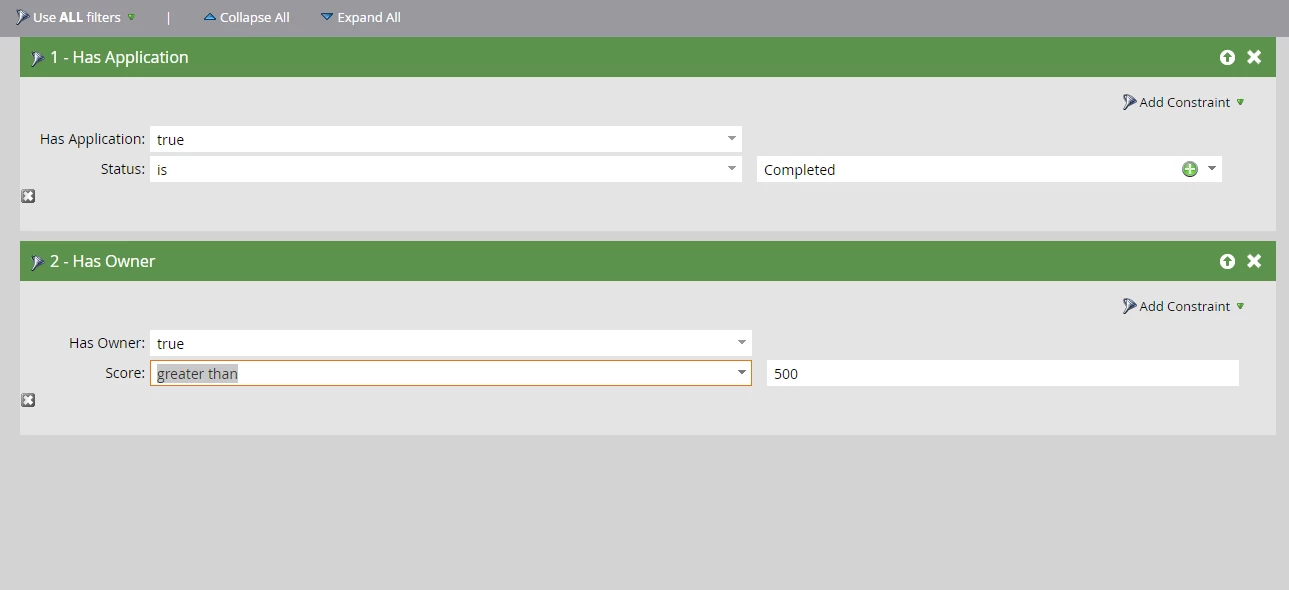
 

However, this approach yields leads with any application that has a "Completed" status and any owner with a score over 500, regardless of whether the owner's application status is "Completed".


Given this situation, the question arises: Is there a feasible method to achieve this type of filtering? Alternatively, should we consider abandoning the use of using custom objects altogether and consolidate all the data within the standard lead object? It's important to note that we're not inclined toward the latter approach as it would lead to a lot of data duplicacy.


Any insights or suggestions regarding this matter would be greatly appreciated.

This post is no longer active and is closed to new replies. Need help? Start a new post to ask your question.

2 replies

SanfordWhiteman
New Participant
August 27, 2023

Similarly, the intention was for the "Owner" object to connect to the "Application" object in a one-to-many manner, signifying that a single application can have multiple owners. However, due to limitations in Marketo, which does not support a second-level custom object relationship (such as Lead <- Parent <- Child),

Hmm, this phrasing is misleading and I don’t want anyone reading this post to get bad info.


Marketo does support many-to-one relationships. You could have an ApplicationApplication XrefLead relationship. The Application Xref is your junction object. It would allow a Lead to be connected to multiple Applications, and other Lead objects could be connected to those same Applications.


The problem with this setup isn’t on the Smart List side. It’s on the Velocity side. Velocity would not be able to read the properties of the Application via the Xref. It would essentially know that an Application exists and its GUID, but nothing else.


To fully enable this setup to work in both SLs and Velocity, you’d need to have a dictionary of all your Application objects stored somewhere else, outside of the CO relationship. For example, you could pack them all into a text {{my.token}} as a JSON array; whenever there’s a net modification to the Application list, rewrite the token (via API of course). Obviously this won’t work if you have too many distinct Applications, but such tokens can be up to 255KB (not sure if there even is a hard limit) so they can get huge.

Darshil_Shah1
Community Manager
August 27, 2023

Yeah, not a lot of users realize this until it's too late/not while creating the CO. You could set up an aux. field on your primary CO linked to the Person object to also store the owner score value, so you're able to pinpoint the exact CO records that have both the criteria in place in the same CO record i.e., Application Status = Completed, and Owner Score > 500 (not just both the criteria in place across multiple CO records). With the as-is approach, Marketo would qualify all the people who have at least one record on the Application CO such that the Status is Completed and Owner CO such that the Owner Score is > 500, and this need not be associated together. Also, Marketo does support accessing data from velocity 2 level deep and second-level custom object relationship though.

New Participant
August 28, 2023

Hi @darshil_shah1 ,
Thanks for the reply.
Regarding this =>


You could set up an aux. field on your primary CO linked to the Person object to also store the owner score value, so you're able to pinpoint the exact CO records that have both the criteria in place in the same CO record i.e., Application Status = Completed, and Owner Score > 500 (not just both the criteria in place across multiple CO records). 

I have multiple owners for this application ( status == "Completed"). Should I understand your suggestion as advising me to include all owner scores within application CO itself? I'd like to mention that the count of owners might differ between applications, and the situation we're discussing is just one example among numerous scenarios.

Regarding this =>


Also, Marketo does support accessing data from velocity 2 level deep and second-level custom object relationship though.

Accessing second-level custom object in email script is fine but how do I create second-level custom object relationship in marketo ?

Darshil_Shah1
Community Manager
August 28, 2023

Could there be a case where a single CO record could have multiple Owners (and, if yes, along the same lines, is the number of owners that could be tied to a single Application CO record not fixed)? I understand you have more than possible Owners, but if a single Application CO record could at a single time have just 1 Owner (or fixed number of owners, but if there's a case where you could have multiple owners, you can always export the CO record data, and filter people who meet your criteria instead of using SL), you can create a couple of fields on the Application object to store the owner name/ID and score. This would allow you to add constraints for the Owner's name and/or his/her score on the same Application CO itself.