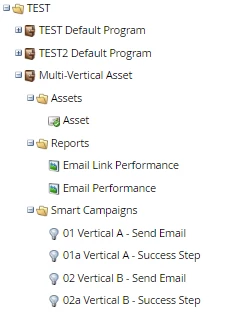
Ah. I think I understand what you're asking.
If you nest the default program within both of the nurture programs, both referring to the same email send smart campaign, you won't be pushing people who get triggered from Nurture A into Nurture B unless something in a flow step of the nested default program explicitly does this.
You can include a filter in the rules of the nested default program email send smart campaign that require the person triggering the send to be a member of either Nurture A or Nurture B, but this won't really do anything - by definition, this is a prerequisite to the campaign being triggered. It's a safety net, but keep in mind that by including this you will need to remember to update the smart campaign before you can add that default program to Nurture C, otherwise it won't work. (This may be fine if you're solo-ing it, but good factor to keep in mind if you've got multiple users).
As I see it you've got three options, in decreasing order of work required:
- Single default program nested across multiple Nurtures, with a separate email send trigger for each Nurture.
- Single default program nested across multiple Nurtures, with a single shared email send smart campaign which does include a member of engagement program filter
- Single default program nested across multiple Nurtures, with a single shared email send smart campaign which does not include a member of engagement program filter.
None of these options will cause people to move around in other nurture programs unless you add something in the flow steps to explicitly ensure this. If you do want to include steps to make this happen but only in the nurture they are a member of, you should either choose #1 or, with #2 or #3, add conditions to flow steps or use request campaign steps (though that has it's own pitfalls...)
Hope that helps.